Catalytic Converter Scrap Prices This Month: What's Moving the Market
Catalytic converter scrap prices are rarely static for long. In August 2026, platinum, palladium and rhodium markets are still giving scrap merchants, breakers, garages and private sellers plenty to watch. Platinum has strengthened from some of its recent lows, palladium remains volatile, while rhodium continues to trade at historically elevated levels despite a changing supply-and-demand picture.
That does not mean every catalytic converter has increased or decreased by the same amount. Far from it. The value of an individual unit depends on its identifying code, the quantity and mix of precious metals it contains, and the latest market-linked pricing.
So, what has actually been moving catalytic converter values this month?
Key Takeaways
- Platinum is trading at around £1,296 per troy ounce as of 18 August 2026, following considerable movement during the past three months.
- Palladium is around £978 per troy ounce, with recent prices still showing fairly sharp short-term swings.
- Rhodium remains highly valuable, with the latest widely reported benchmark around £6,096 per troy ounce when converted into sterling (18 August exchange rate). Its market is considerably less liquid than platinum or palladium.
- Metal movements affect converters differently because PGM loadings vary considerably between units.
- A current converter-specific price is more useful than an old online estimate or a generic catalytic converter scrap price per kg.
What Are Platinum, Palladium and Rhodium Doing This Month?
Platinum has been one of the more interesting PGM (Platinum Group Metals) markets in 2026.
On 18 August, UK platinum spot pricing was around £1,296 per troy ounce (1 troy ounce = 31.1 grams). During the previous three months, it has moved between roughly £1,162 and £1,498 per ounce, showing why valuations from even a few weeks ago can quickly become dated.
The fundamental backdrop remains relatively supportive. Johnson Matthey expects platinum demand to exceed supply again in 2026, marking a fourth consecutive year of market deficit. Lower mine shipments from major producing regions, including South Africa and Russia, remain part of that picture.
Palladium is different. Current UK pricing is around £978 per troy ounce. Earlier this month, UK market references were closer to £960 per ounce, so the metal has moved upward, but it remains well below the peaks seen during earlier periods of tight supply.
Johnson Matthey expects palladium demand to fall during 2026, with lower petrol vehicle production contributing to weaker automotive consumption. The market could consequently move into a small surplus after years of persistent deficits.
Rhodium remains the standout by price, with recent benchmark data around the equivalent of £6,096 per troy ounce. It also rose during July, with Trading Economics reporting a monthly increase of more than 4% at the end of that month.
Its longer-term outlook is less straightforward. Recycling supply is recovering and automotive rhodium demand is forecast to soften, meaning the market could also record a modest surplus during 2026.
In short, the three metals are no longer moving as one neat group, but they did all slightly grow in value compared to the previous month.
Why Are Catalytic Converter Scrap Prices Moving?
Precious-metal prices are important, but they are only part of the calculation.
Global PGM supply remains heavily influenced by mining output in South Africa and Russia. Mine disruption, production cuts or weaker output can tighten availability relatively quickly. Johnson Matthey expects combined primary and secondary platinum supply to contract in 2026, while Russian palladium production is forecast to fall to its lowest level in at least two decades.
Vehicle trends matter too. Battery-electric vehicles do not use traditional exhaust catalytic converters, which gradually reduces one source of PGM demand as adoption grows. Hybrid vehicles still require catalytic converters, though, and their continued popularity means the shift is not as simple as “more EVs equals no more demand”.
There is also demand outside the automotive industry. Platinum is used in areas including chemicals, glass manufacturing, data storage and emerging hydrogen technologies. Industrial PGM consumption therefore adds another layer to market pricing.
And recycling itself feeds back into the market. Higher PGM prices can encourage more end-of-life converters into the recycling chain, increasing secondary metal supply.
Is There a Catalytic Converter Scrap Price Per Kg?
This is one of the most common questions around converter values, but there is no single reliable catalytic converter scrap price per kg.
Two converters of a similar size and weight can have very different values because their internal PGM content may be different.
A small converter with a relatively valuable precious-metal loading could be worth more than a physically heavier unit with less recoverable PGM content. Manufacturer, vehicle model, converter design and identifying code can all matter.
For that reason, MetCat purchases complete scrap catalytic converters by piece according to their identifying code, rather than applying one universal price per kilogram.
If you have several units sitting in a workshop or yard, weighing the pile might tell you how much material you have, but it will not tell you accurately what those converters are worth.
Why the Converter Code Matters
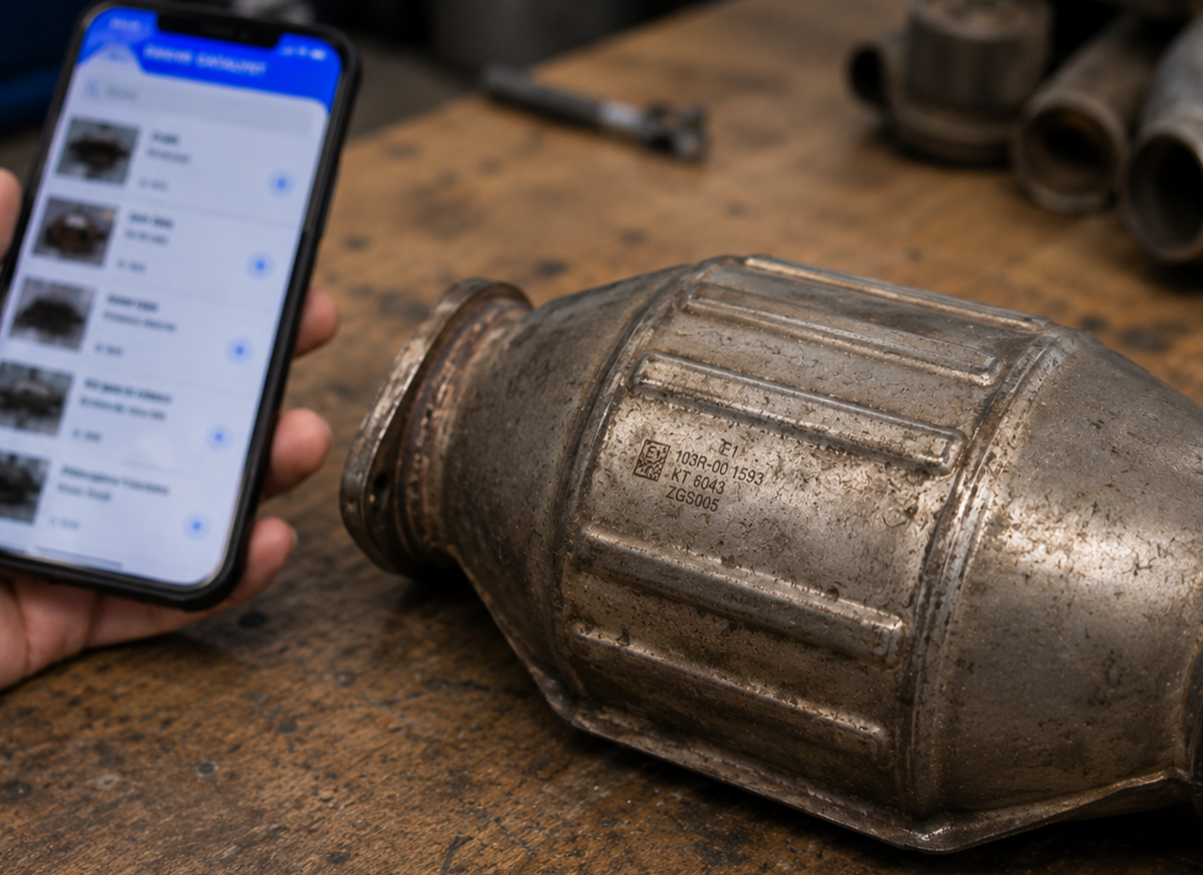
The identifying code is one of the most useful pieces of information when establishing a current value.
It allows a converter to be matched to known information about that particular unit rather than valued purely from its size, shape or appearance.
This becomes especially important in a month where platinum, palladium and rhodium are moving differently. A converter with a stronger platinum loading will not necessarily react to market changes in the same way as one containing more palladium or rhodium.
If you want more background on the materials involved, read this guide on what materials are in a catalytic converter.
How to Check What Your Catalytic Converter Is Worth Today
Historic price lists can give context, but they are less useful when the underlying PGM markets are moving. The simplest route to check live converter prices is on the MetCat App, where pricing is linked to current precious-metal markets and updated daily.
MetCat is open to both trade and public customers and offers collection alongside drop-off at its Wolverhampton site. For suppliers who prefer a direct valuation, you can also request a free quote from MetCat.
FAQs
Are catalytic converter scrap prices going up in August 2026?
There is no single market-wide answer because different converters contain different PGM combinations. Platinum and palladium have both moved during August, while rhodium remains at a high absolute price.
How much is a catalytic converter worth in scrap in the UK?
Values vary significantly by converter type and identifying code. A generic UK average can therefore be misleading. Current converter-specific pricing is more useful than relying on an old estimate.
What affects catalytic converter scrap prices the most?
Key factors include platinum, palladium and rhodium prices, the amount of each metal inside the converter, global PGM supply and demand, automotive production, recycling volumes and the individual converter code.
Is catalytic converter scrap priced per kg?
Complete catalytic converters are often valued by their individual type or identifying code rather than simply by weight. MetCat purchases converters by piece according to their code, so there is no universal catalytic converter scrap price per kg.
How often do catalytic converter prices change?
They can change frequently as precious-metal markets move. MetCat updates prices daily through the MetCat App, which makes current pricing more useful than historic price lists.
Keep an Eye on the Converter, Not Only the Metal Price
August’s PGM market is a useful reminder that catalytic converter values do not move in one straight line.
Platinum currently has a tighter supply outlook, while palladium and rhodium face the possibility of modest market surpluses. At the same time, geopolitical risk, mine supply, recycling volumes, vehicle production and industrial demand continue to pull prices in different directions.
For sellers, the practical takeaway is simpler. Identify the converter first, then check what that specific unit is worth at today’s prices. Watching the precious-metal market helps explain the movement, but current converter-level pricing tells you what actually matters when it is time to sell.